Userlist vs Customer.io for B2B SaaS: Cost and Fit
Userlist vs Customer.io for a B2B SaaS: published prices at 10,000 to 32,000 users, how each handles companies, and which team should pick which.
Short answer
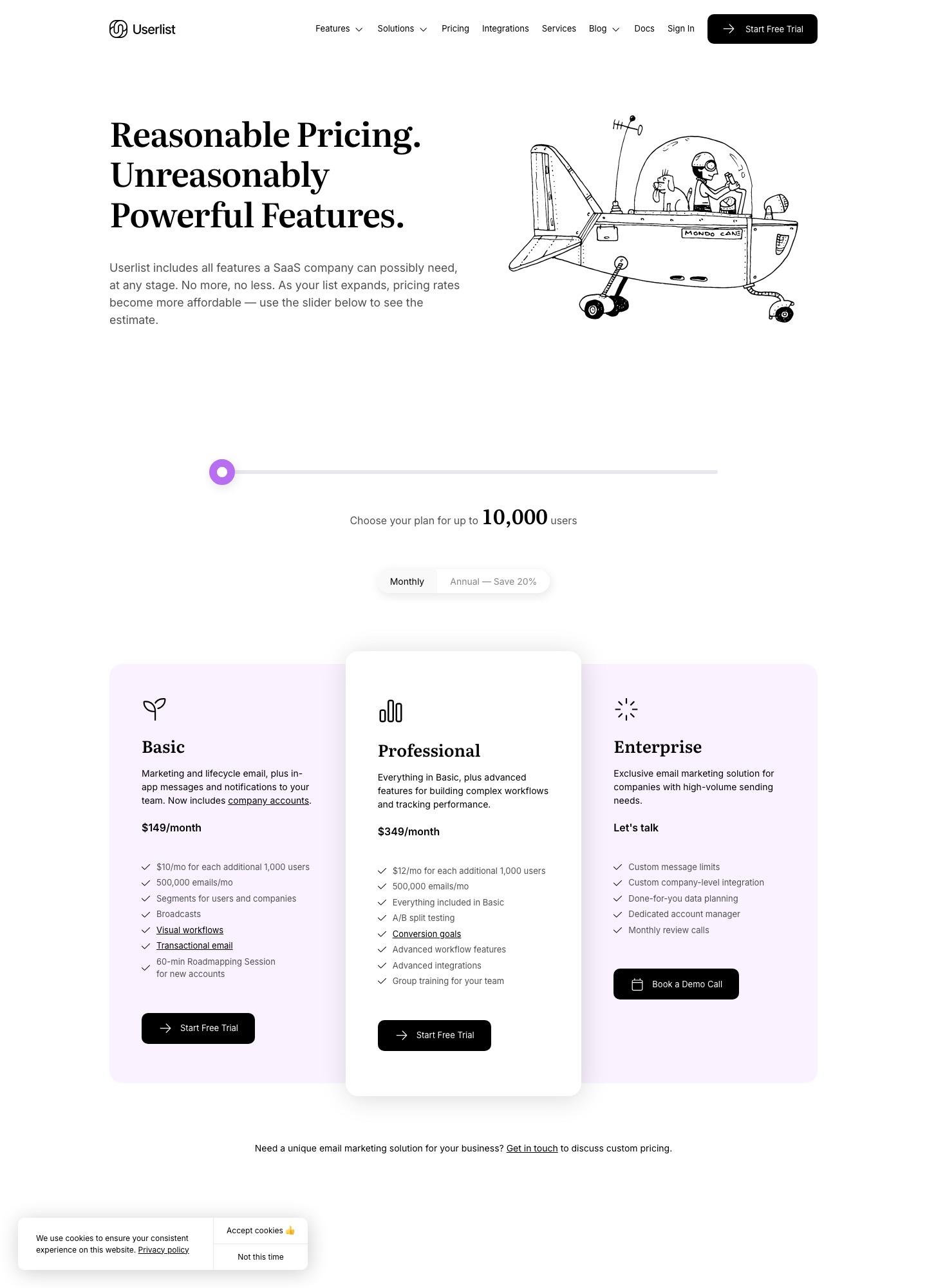
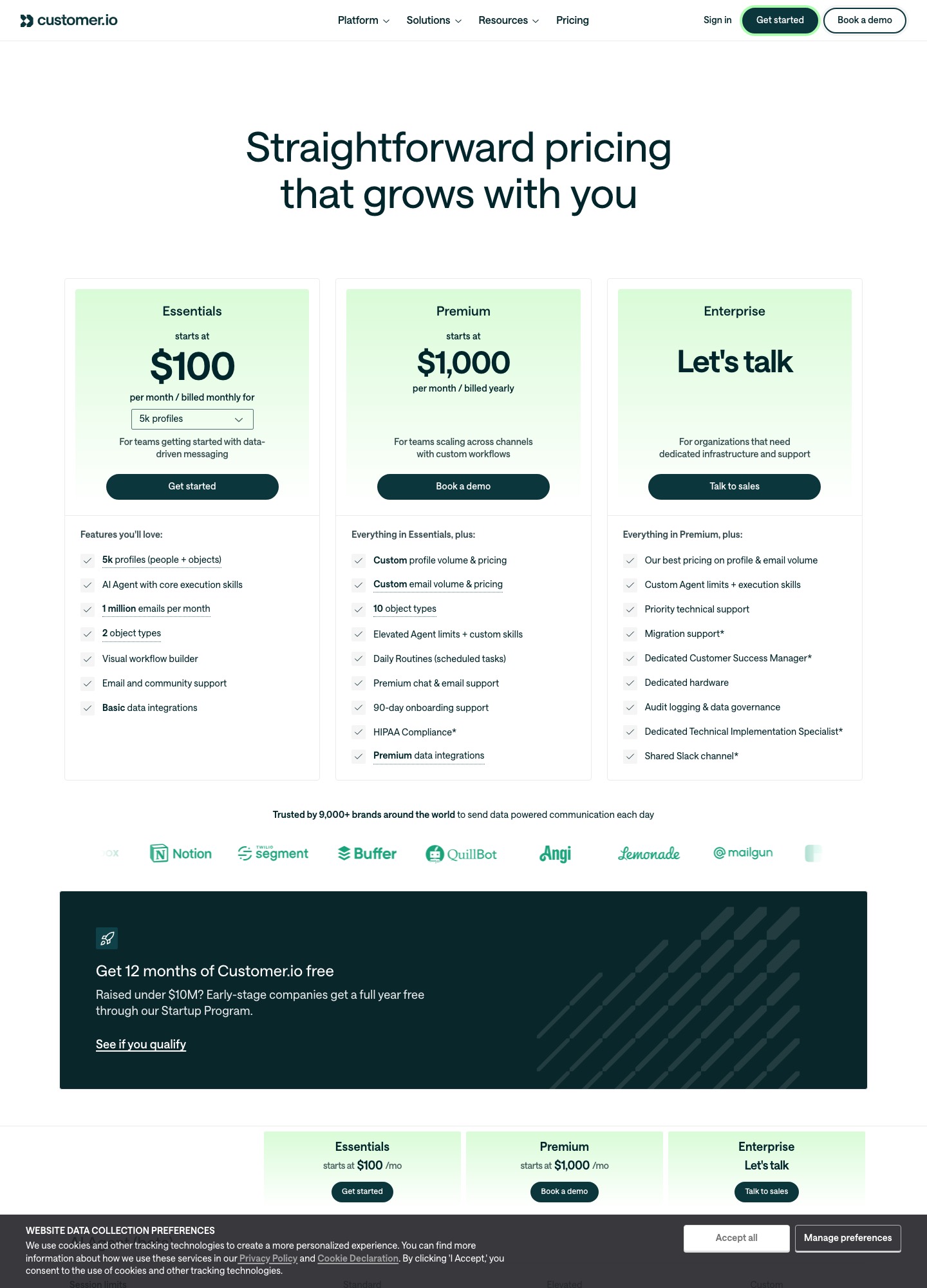
If your customers are companies with several users each, and you want to message by account (every admin of a company that has not logged in for a month, say), Userlist is built around that and costs $149 a month at up to 10,000 users on Basic. If your product is closer to a consumer or prosumer app, or you want push, in-app and WhatsApp channels and a lower entry price, Customer.io starts at $100 a month for 5,000 profiles and is $145 at 10,000.
The money is closer than most comparisons suggest. At 10,000 users or profiles the entry plans are $149 and $145. The step that changes the bill is inside Userlist: A/B split testing, conversion goals and advanced workflow features sit in Professional, which is $349 at 10,000 users. Prices below were read from userlist.com/pricing and customer.io/pricing on 7 October 2026.
At a glance
| Feature | Userlist | Customer.io |
|---|---|---|
| Entry price | Basic $149/mo at up to 10,000 users (no lower step on the slider) | Essentials $100/mo at 5,000 profiles |
| Top self-serve plan | Professional $349/mo at up to 10,000 users | Premium from $1,000/mo, billed yearly |
| Growth rate | +$10 (Basic) or +$12 (Professional) per extra 1,000 users | $0.009 per extra profile on Essentials |
| Email volume included | 500,000 emails/mo; $1 per extra 1,000 messages | 1 million emails/mo; $0.12 per extra 1,000 |
| Companies and accounts | Segments for users and companies on Basic | Object types: 2 on Essentials, 10 on Premium |
| Channels listed | Email and in-app messages, plus notifications to your own team | Email, push, in-app, WhatsApp; SMS with custom volume |
| Free offer | Free trial (no free plan shown) | 12 months free if you raised under $10M |
How the two handle a B2B account
Companies as a built-in concept versus objects you define
Userlist's pricing page describes Basic as marketing and lifecycle email plus in-app messages, with "segments for users and companies" and company accounts called out by name. In practice that means you send Userlist a company record with its users, then build a segment on company fields (plan, team size, last activity) and target the people inside it. You do not design the data model first.
Customer.io's Essentials plan includes two object types, and Premium raises that to ten. Objects are the mechanism for modelling a company, a workspace or a project and linking people to it. They work, but you decide the schema, send the relationship data from your backend, and test the segments. Teams with an engineer who enjoys that get flexibility; teams without one get a project.
What a "user" costs on each side
Userlist's billing docs state that every plan includes a monthly message allowance of five times your tracked user count, with a floor of 500,000 messages, and that overage costs $1 per 1,000 additional messages. Customer.io counts profiles (people plus objects), so each company you model as an object adds to the tier, and a profile counts for the month even if you delete it before month end. The two meters are close at 10,000, but a B2B product with many small accounts will feel the object count on Customer.io and the user count on Userlist.
Plan gating: what you only get on the upper plan
Userlist keeps A/B split testing, conversion goals, advanced workflow features, advanced integrations and group training for Professional, $349 at up to 10,000 users, and offers a dedicated account manager and monthly review calls only on Enterprise. Customer.io's gating runs along different lines: Essentials excludes managed deliverability, which Premium includes, and Essentials support is email and community.
Channels
Userlist's page names email and in-app messages, and describes notifications that go to your own team. Customer.io lists email, push, in-app and WhatsApp, with SMS volume custom. If your B2B product is a web app and your users read email, the shorter Userlist list is enough; if you need push to a mobile app, it is not on Userlist's page.
Published prices at comparable sizes
Userlist's slider starts at 10,000 users, so there is no published Userlist price for a 1,000 or 5,000-user list; Customer.io's first step is 5,000 profiles. The readouts below are monthly list prices from 7 October 2026. The sizes do not line up exactly because each vendor's slider uses its own steps, so the table pairs the nearest ones and says which is which.
| Size | Userlist Basic | Userlist Professional | Customer.io Essentials |
|---|---|---|---|
| 5,000 | No step below 10,000 users | No step below 10,000 users | $100/mo |
| 10,000 | $149/mo | $349/mo | $145/mo |
| 18,000 (Userlist) / 20,000 (Customer.io) | $229/mo | Not read | $235/mo |
| 30,000 (Customer.io) / 32,000 (Userlist) | $369/mo | Not read | $325/mo |
| 50,000 | Not read | Not read | $505+/mo |
At 10,000 the entry plans are $4 apart, and at the nearest steps above that Userlist Basic is slightly cheaper at 18,000 users ($229 against $235 at 20,000 profiles) and about $44 dearer at 32,000 against 30,000 ($369 against $325). The honest reading is that Basic and Essentials cost about the same for a list of this size, and the decision is features and data model, not subscription price. The expensive decision is Professional: $349 at 10,000 users is more than double Customer.io's $145, so check that you actually need A/B testing and conversion goals before you price Userlist on that tier. Userlist also shows an annual toggle labelled "Save 20%" on its page; Customer.io's Essentials readouts are billed monthly.
Userlist publishes no price for Enterprise (custom, "Let's talk"), and Customer.io's Premium starts at $1,000 a month billed yearly with custom profile volume.
Pros and Cons
Userlist
Pros
- + Segments for users and companies on the entry plan
- + Visual workflows, broadcasts and transactional email on Basic
- + In-app messages included, plus 60-minute roadmapping session for new accounts
- + Basic is $229/mo at 18,000 users, $369/mo at 32,000
- + 500,000 emails/mo included on Basic and Professional
Cons
- - No published price below 10,000 users
- - A/B testing and conversion goals need Professional ($349/mo at 10,000)
- - No SMS, push or WhatsApp on the pricing page
- - Enterprise is custom pricing only
Customer.io
Pros
- + $100/mo at 5,000 profiles, $145/mo at 10,000
- + Email, push, in-app and WhatsApp channels
- + 1 million emails/mo included on Essentials
- + 12 months free for startups that raised under $10M
- + $145/mo at 10,000 against Userlist Professional's $349
Cons
- - Company model is objects you design (2 types on Essentials)
- - Managed deliverability not on Essentials
- - A profile deleted mid-month is still billed that month
- - Premium starts at $1,000/mo billed yearly
Which team should pick which
A small B2B team with no spare engineer
Userlist. Company segmentation is on the entry plan, and Basic is $149 at 10,000 users, within $4 of Customer.io Essentials at the same size. You skip the object schema work, and the included roadmapping session helps a first-time setup. Stay on Basic unless you really need split tests.
A B2B product that also has a mobile app or wants push and in-app prompts
Customer.io. Push, in-app and WhatsApp are on its pricing page, and Userlist's page lists email and in-app only. Plan for an engineer to define company objects.
A seed-stage startup with a list under 10,000 users
Customer.io. Userlist shows no price below 10,000 users, so you would pay the 10,000-user rate for a smaller list, while Customer.io has a $100 step at 5,000 profiles and a free year if you raised under $10 million.
A team that wants experiments and conversion tracking inside the tool
Userlist Professional lists A/B split testing and conversion goals explicitly, but it costs $349 at 10,000 users. Compare that with Customer.io at $145 and check Customer.io's feature table for the testing features you need before paying the gap.
Bottom line
For a B2B SaaS with a list of 10,000 users or more, no engineer to spare, and email as the main channel, Userlist's Basic plan is the better fit: the price is level with Customer.io, and companies are native. For a B2B SaaS under 10,000 users, a mobile or multi-channel product, or a team that wants a year of free runway, Customer.io is the better fit. Only move to Userlist Professional if split testing is a requirement, because it more than doubles the monthly cost against Customer.io at 10,000.
If you run a SaaS
If your B2B product mostly needs trial, onboarding and payment-failure emails, Sequenzy is a lighter, per-email option: free for 2,500 emails a month and $19 for 15,000 on its pricing page, with unlimited contacts. It has no company-level model comparable to Userlist's, so it suits individual-user journeys.
Frequently asked questions
How much does Userlist cost?
Basic is $149 a month at up to 10,000 users, with $10 a month for each additional 1,000 users; Professional is $349 at the same size with $12 per extra 1,000. Enterprise is custom. Userlist's slider shows $229 for Basic at 18,000 users and $369 at 32,000.
Is Customer.io cheaper than Userlist?
Slightly, at comparable sizes: $145 at 10,000 profiles against Userlist Basic's $149, and $325 at 30,000 against $369 at 32,000 users. Against Userlist Professional ($349 at 10,000) the gap is much larger.
Does Userlist have a free plan?
Its pricing page shows free-trial buttons on Basic and Professional and no free plan. Customer.io has no free plan either, but offers 12 months free through its Startup Program to companies that have raised under $10 million.
Looking at Userlist for other reasons?
Read the Userlist alternatives guide, or compare Customer.io with Drip if a commerce-style tool is also on your list.
Browse startup alternatives